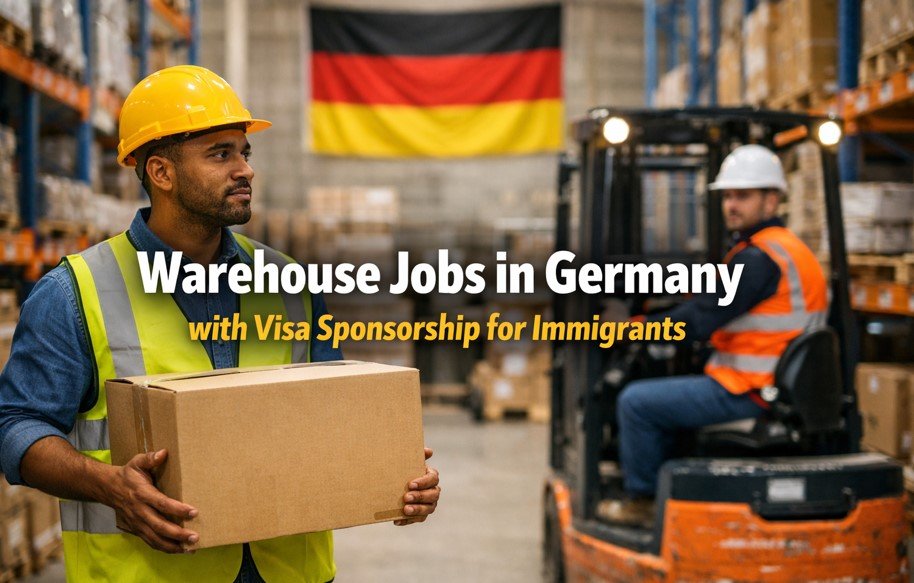
Finding Warehouse Jobs in Germany is becoming a top priority for international job seekers looking for a stable career in the heart of Europe’s logistics hub.
Warehouse Jobs in Germany offer not only competitive salaries but also a clear pathway for immigrants to secure legal residency through various visa sponsorship programs and the newly introduced “Opportunity Card.”
The demand for Warehouse Jobs in Germany has skyrocketed in 2026 as the country continues to expand its e-commerce and global distribution networks.
Whether you are an experienced forklift operator or looking for entry-level packing roles, Warehouse Jobs in Germany provide a diverse range of opportunities for those willing to relocate and contribute to a world-class supply chain.
Why Germany is the Best for Warehouse Jobs
Finding Warehouse Jobs in Germany is often the first step for many immigrants looking to build a stable life in Europe. Germany isn’t just a random choice; it is widely considered the gold standard for logistics and warehousing globally.
Below is an extensive breakdown of why the German market stands head and shoulders above its neighbors and other international destinations for professionals in this sector.
Unmatched Global Leadership in Logistics Infrastructure
The primary reason Warehouse Jobs in Germany are so abundant and stable is due to the country’s status as the “Logistics World Champion.” According to the World Bank’s Logistics Performance Index, Germany consistently ranks at the very top, thanks to its sophisticated infrastructure.
The country serves as the central transit hub for the entire European Union. Whether goods are coming from the massive Port of Hamburg, the global air-freight hub at Frankfurt Airport, or via the dense network of high-speed rail and “Autobahn” highways, they all pass through German warehouses.
For a worker, this means the industry is not just a trend, it is the backbone of the national economy. This infrastructure ensures that even during global economic shifts, the demand for storage, sorting, and distribution remains constant, providing a level of job security that is hard to find elsewhere.
Strongest Labor Protections and Worker Rights in Europe
When you secure Warehouse Jobs in Germany, you enter one of the most protected labor environments in the world. German law is designed to prevent worker exploitation, ensuring that everyone, regardless of their nationality, is treated with dignity.
The “Working Time Act” (Arbeitszeitgesetz) strictly limits regular shifts to 8 hours, and while extensions to 10 hours are possible, they must be compensated with immediate time off. Furthermore, most large warehouses have a “Betriebsrat” (Works Council).
These are groups of employees elected to represent their colleagues’ interests to management, covering everything from safety protocols to fair shift scheduling.
This democratic approach to the workplace ensures that your voice is heard and that your physical and mental health are prioritized over simple profit margins.
Industry-Leading Statutory Benefits and Social Security
One of the most attractive features of Warehouse Jobs in Germany is the comprehensive “social safety net” that comes with every legal employment contract.
In Germany, social security isn’t just a deduction on your paycheck; it is an investment in your future. As of 2026, employers contribute roughly 20% of your gross salary toward mandatory programs on your behalf. This includes:
- Statutory Health Insurance: Giving you and your family access to some of the world’s best doctors and hospitals with almost no out-of-pocket costs.
- Pension Insurance: Ensuring that your years of hard work in the warehouse translate into a stable retirement income.
- Nursing Care and Unemployment Insurance: Providing a financial cushion in case of long-term illness or unexpected job loss.
Additionally, workers are entitled to a minimum of 20 to 30 days of paid vacation per year, plus up to six weeks of full pay if you fall ill, allowing you to recover without the fear of losing your income.
Competitive Wages and the 2026 Minimum Wage Increase
The financial rewards for Warehouse Jobs in Germany have seen a significant boost recently. As of January 1, 2026, the statutory minimum wage in Germany has been increased to €13.90 per hour.
This provides a very high “income floor,” ensuring that even entry-level packers and sorters earn enough to live comfortably. For those with specialized skills, such as forklift operators or inventory managers, hourly rates often climb between €16 and €20.
Furthermore, German logistics companies are famous for their “Zulagen” (bonuses). If you work a night shift, a Sunday, or a public holiday, you can expect an additional 25% to 50% on top of your base hourly rate.
This transparent and regulated pay structure makes financial planning much easier for immigrants compared to countries with less regulated labor markets.
Rapid Career Advancement and Vocational Training (Ausbildung)
Unlike many countries where a warehouse role is seen as a “dead-end” job, Warehouse Jobs in Germany are part of a highly respected professional career path. Germany utilizes a “Dual Education System” where workers can undergo an Ausbildung (vocational training) while they work.
You can start as a simple helper and, within a few years, become a certified “Specialist in Warehouse Logistics” (Fachkraft für Lagerlogistik).
This certification is recognized nationwide and can nearly double your earning potential. German employers prefer to promote from within; a dedicated picker who shows leadership skills can quickly move into a Team Lead or Shift Supervisor role.
The industry actively encourages lifelong learning, often paying for workers to get their forklift licenses (Staplerschein) or dangerous goods handling certifications (ADR).
A Welcoming Landscape for International Immigrants
Finally, Germany is currently leading the way in “Active Recruitment” for the logistics sector. With a significant labor shortage in the supply chain, the government has simplified the “Skilled Immigration Act” to make it easier for non-EU citizens to fill Warehouse Jobs in Germany.
The introduction of the “Opportunity Card” in the last few years allows job seekers to move to Germany and look for work locally, significantly lowering the barrier to entry.
Many German logistics firms now offer “Relocation Packages” that include assistance with finding an apartment, opening a bank account, and enrolling in German language classes. This holistic approach to immigration means you aren’t just a number in a warehouse; you are a valued member of the community being supported as you integrate into German society.
Warehouse Jobs in Germany with Visa Sponsorship for Immigrants
The German logistics sector is a powerhouse of opportunity for international workers, offering a structured environment where every role is essential to the global supply chain.
Below are the key Warehouse Jobs in Germany that frequently offer visa sponsorship for immigrants, detailed with their current 2026 salary expectations and professional requirements.
1. Warehouse Helper (Lagerhelfer)
Average Salary: €31,321 – €40,244 per year
As an entry-level position, the Warehouse Helper role is one of the most accessible Warehouse Jobs in Germany for immigrants who may still be developing their language skills.
These workers are responsible for the manual handling of goods, including unloading shipping containers, sorting items based on internal logistics codes, and maintaining a clean and safe workspace.
Because the barrier to entry is lower in terms of formal vocational training, many large distribution centers use this role as a starting point for international recruits, often providing on-the-job training and basic German language support to help new arrivals integrate into the workforce.
2. Order Picker (Kommissionierer)
Average Salary: €31,321 – €36,500 per year
Order Pickers are the precision engine of the fulfillment center, tasked with accurately gathering specific items from the shelves to complete customer orders.
In 2026, many Warehouse Jobs in Germany for pickers involve using advanced “Pick-by-Voice” or digital scanning technology, which requires a basic level of numerical and linguistic comprehension.
Immigrants in this role must be physically fit and capable of meeting performance targets while ensuring that every package contains the correct quantity and quality of goods, making it a vital role for the booming German e-commerce sector.
3. Forklift Operator (Staplerfahrer)
Average Salary: €38,958 – €45,000 per year
Holding a forklift license, known in Germany as a Staplerschein, significantly increases your market value and chances of securing visa sponsorship. Forklift operators are responsible for moving heavy pallets and bulk materials across the warehouse floor and into high-rack storage systems.
This role requires a high degree of safety awareness and technical skill, and because it is classified as a semi-skilled position, German employers are often very willing to sponsor the visas of qualified international drivers to fill critical gaps in their logistics chain.
4. Reach Truck Operator (Schubmaststaplerfahrer)
Average Salary: €36,186 – €54,349 per year
Reach Truck Operators are specialists who handle advanced machinery designed for narrow aisles and extreme heights, often reaching up to 13 meters.
These Warehouse Jobs in Germany are more technically demanding than standard forklift roles and typically offer higher compensation for the specialized skill set required to navigate complex high-bay warehouses.
For immigrants, demonstrating experience with reach trucks can be a major advantage during the recruitment process, as these operators are essential for maximizing the vertical storage capacity of modern distribution hubs.
5. Warehouse Clerk (Lagerist)
Average Salary: €31,784 – €45,480 per year
A Warehouse Clerk manages the intersection of physical labor and digital inventory management, ensuring that all incoming and outgoing goods are correctly logged into the company’s Warehouse Management System (WMS).
This role involves a significant amount of administrative work, including checking delivery notes, preparing shipping documents, and communicating with truck drivers and office staff.
For immigrants with prior office experience and intermediate German or English skills, this position offers a professional environment with excellent long-term career stability in the logistics sector.
6. Logistics Technician (Logistiktechniker)
Average Salary: €49,963 – €58,000 per year
Logistics Technicians focus on the technical and mechanical aspects of the warehouse, often overseeing the automated conveyor systems, robotic picking arms, and sorting machines that define 2026 logistics.
These Warehouse Jobs in Germany are ideal for immigrants with a background in mechanics or electronics, as the role involves routine maintenance, troubleshooting equipment failures, and optimizing the flow of goods through the facility.
Because of the technical expertise required, these positions are highly eligible for the Skilled Worker Visa, reflecting the high value placed on technical proficiency.
7. Inventory Controller (Bestandskontrolleur)
Average Salary: €73,524 – €94,907 per year (Senior Level)
Inventory Controllers are responsible for the financial and physical accuracy of the warehouse’s stock levels, performing regular audits and cycle counts to prevent discrepancies.
This is a high-responsibility role that requires a meticulous eye for detail and strong mathematical skills to investigate “shrinkage” or losses within the system.
In Germany, senior inventory controllers with several years of experience can earn substantial salaries, and their expertise in supply chain management makes them prime candidates for visa sponsorship programs targeting highly skilled professionals.
8. Warehouse Shift Supervisor (Schichtführer)
Average Salary: €47,402 – €80,245 per year
Shift Supervisors act as the bridge between upper management and the floor staff, ensuring that production targets are met safely and efficiently during their designated hours.
Immigrants who have demonstrated leadership skills and a strong understanding of German warehouse operations can move into these roles to oversee teams of pickers, packers, and drivers.
The role involves managing schedules, resolving conflicts, and ensuring strict adherence to health and safety regulations, making it a critical leadership position within any large-scale logistics operation.
9. Packaging Specialist (Verpackungsmittelmechaniker)
Average Salary: €37,288 – €59,530 per year
Packaging Specialists ensure that goods are prepared for transit using the most efficient and secure methods possible, often working with specialized machinery to create custom crates or protective wrapping.
These Warehouse Jobs in Germany have become increasingly important as companies strive for sustainability, requiring specialists to optimize packaging materials to reduce waste while maintaining safety.
For immigrants with experience in manufacturing or material science, this role offers a unique niche within the logistics industry that rewards technical creativity and precision.
10. Shipping and Receiving Coordinator
Average Salary: €41,398 – €48,000 per year
Shipping and Receiving Coordinators manage the “gates” of the warehouse, overseeing the schedules of incoming trucks and outgoing delivery vehicles to prevent bottlenecks.
This role requires exceptional organizational skills and the ability to multitask in a fast-paced environment, as you must verify that every shipment matches its digital manifest.
For an immigrant, this role provides a great deal of exposure to different parts of the supply chain and is often a prerequisite for moving into higher-level logistics management or supply chain coordination roles.
11. Quality Control Inspector
Average Salary: €44,535 – €52,000 per year
Quality Control Inspectors are responsible for ensuring that all products leaving the warehouse meet the strict “Made in Germany” standards or the specific requirements of the client.
They inspect goods for damage, verify expiration dates for perishable items, and ensure that the labeling is accurate for international export.
This role is perfect for detail-oriented immigrants who want to work in a setting that values precision over speed, and it is a common role in warehouses dealing with pharmaceuticals, electronics, or luxury goods.
12. Warehouse Manager (Lagerleiter)
Average Salary: €41,905 – €79,000 per year
The Warehouse Manager holds ultimate responsibility for the facility’s performance, budgeting, and personnel management, making it one of the most senior Warehouse Jobs in Germany.
This role involves high-level strategic planning, negotiating with transport vendors, and implementing new technologies to improve efficiency across the board.
While many managers are promoted from within, there is a strong market for experienced international managers with a proven track record in global logistics to bring fresh perspectives and international standards to German facilities.
13. Supply Chain Coordinator
Average Salary: €50,678 – €62,000 per year
Supply Chain Coordinators operate at a higher level of the logistics hierarchy, focusing on the movement of goods between multiple warehouses, suppliers, and end-customers.
This role requires a holistic understanding of the entire distribution network and often involves using complex ERP software to forecast demand and manage lead times.
Immigrants with degrees in logistics, business, or engineering are frequently recruited for these roles, as their international experience can be a major asset for German companies operating on a global scale.
Step-by-Step Guide to Applying from Abroad
Moving from your home country to secure Warehouse Jobs in Germany is a process that requires precision, patience, and a strategic approach to the German labor market.
Because German employers value formal structure and documentation, following these steps accurately will significantly increase your chances of obtaining a work contract and the subsequent visa sponsorship.
1. Crafting a Professional German-Style CV (Der Lebenslauf)
The first and most critical step in securing Warehouse Jobs in Germany is rewriting your resume to fit the “Europass” or traditional German “Lebenslauf” format. Unlike the narrative-heavy resumes used in North America, a German CV must be strictly chronological, factual, and formatted in a clean table style.
You should include a professional headshot (though not legally mandatory, it remains a standard practice in the German logistics industry), your date of birth, and your current residency status.
Focus heavily on listing specific technical skills, such as experience with Warehouse Management Systems (WMS), types of forklifts you have operated, and any safety certifications you hold.
A well-organized CV signals to a German recruiter that you understand their professional culture and are serious about integrating into their workforce.
2. Obtaining the “Staplerschein” and Credential Recognition
If you are applying for skilled Warehouse Jobs in Germany, such as a forklift operator or logistics technician, you must verify if your current licenses are valid in the European Union.
Germany has very strict health and safety regulations (DGUV), and most employers will require you to eventually obtain a German forklift license, known as a Staplerschein.
While you are still abroad, you should use the “Anerkennung in Deutschland” (Recognition in Germany) portal to see if your vocational diplomas or certificates can be officially equated to a German degree.
Having a “Statement of Comparability” from the Central Office for Foreign Education (ZAB) can fast-track your visa application because it proves to the embassy that you are a “Skilled Worker” under the new 2026 immigration laws.
3. Targeting “Visa-Ready” Employers and Job Portals
Not every warehouse has the legal department necessary to process an international sponsorship, so you must target your search toward companies known for hiring globally.
To find Warehouse Jobs in Germany that offer sponsorship, focus your efforts on the “Make it in Germany” official government job board, as well as private portals like StepStone, Indeed Germany, and LinkedIn.
Use specific German keywords like Visum Sponsoring, Quereinsteiger (for career changers), or Englischsprachig (English speaking) in your search queries.
Additionally, reaching out to specialized international recruitment agencies that focus on the “Blue-Card” or “Opportunity Card” sectors can help you find “hidden” roles in large distribution centers that aren’t always advertised on standard public boards.
4. Navigating the German Language Requirement (A1 to B1)
While many large-scale Warehouse Jobs in Germany, especially those in international hubs, operate partially in English, demonstrating a basic command of the German language is a massive competitive advantage.
For the “Opportunity Card” (Chancenkarte), having at least an A1 or A2 level of German provides you with essential points needed for the visa. Even if the job description says “English only,” being able to show a Goethe-Institut or TELC certificate during your interview proves that you are committed to long-term integration.
In a warehouse environment, knowing basic German commands is vital for safety and communication with local team leads, so starting an intensive language course while you are still in your home country is a highly recommended investment.
5. Mastering the Virtual Interview for Logistics Roles
Once your application catches an employer’s eye, the next step for Warehouse Jobs in Germany is the remote interview, typically conducted via Microsoft Teams or Zoom.
German interviews are known for being direct and technical; the hiring manager will likely ask specific questions about your physical stamina, your experience with shift work (Schichtarbeit), and your ability to handle high-pressure environments like “Peak Season” (the period leading up to Christmas).
You should be prepared to explain exactly why you want to move to Germany and how long you intend to stay. Showing that you have already researched the cost of living in Germany and the specific logistics of the visa process demonstrates a level of “German-style” preparedness that recruiters find highly impressive.
6. Securing the Job Offer and the “Vorabzustimmung”
The turning point in your journey is receiving the formal job offer and the employment contract. For Warehouse Jobs in Germany to qualify for a visa, the contract must meet certain criteria: the salary must be in line with local German standards (to prevent wage dumping), and the job description must be clearly defined.
In many cases, your employer will apply for a “Vorabzustimmung” (pre-approval) from the Federal Employment Agency (Bundesagentur für Arbeit). This document essentially confirms that no suitable German or EU citizen was available to fill the role and that your employment is authorized.
Having this pre-approval in your hand before you go to the German embassy in your home country can reduce your visa processing time from months to just a few weeks.
7. The Visa Application and Moving Logistics
The final step is the formal visa application at the German Consulate or Embassy. Depending on your qualifications, you will apply for the “Skilled Worker Visa” or the “Opportunity Card.”
You will need to present your signed contract, proof of health insurance (which some employers provide as part of the relocation package), and proof of a place to stay for at least the first month.
Many large logistics companies that offer Warehouse Jobs in Germany to immigrants will provide “Staff Housing” or help you find a temporary apartment to get you started. Once the visa is stamped in your passport, you are ready to book your flight and begin your new career in one of the world’s most stable and rewarding logistics markets.
Conclusion
Securing Warehouse Jobs in Germany is a viable, rewarding path for immigrants in 2026. The combination of high wages, exceptional labor protections, and a welcoming new visa system makes it one of the best times in history to make the move. By focusing on gaining basic language skills and targeting large international employers, you can turn a warehouse role into a lifelong career in Europe.